
Why the Behaviour You See Today Is Only One Part of the Story
It would be easy to label a teenager with traumatic past as aggressive, impossible and difficult. But what if I told you that this girl is also the same child who used to sing while she baked with her gran? That she once loved horses and wanted to be a veterinary doctor? That the ‘aggression’ you see right now is not her personality, but her armour?
Over more than a decade working as a Consultant Child and Adolescent Psychiatrist in the NHS, I’ve sat with countless residential care staff and parents who are exhausted, hurt, and sometimes frightened by the young people they are trying so hard to support. They tell me they feel stuck between a child’s volcano like behaviour and a system (school, family home or children’s home) that demands control. But what consistently transforms those relationships, and those children’s lives, is not a new behaviour management technique or therapy. It’s a shift in perspective. It’s learning to navigate the child’s whole inner landscape, not just the jagged peak you first notice.
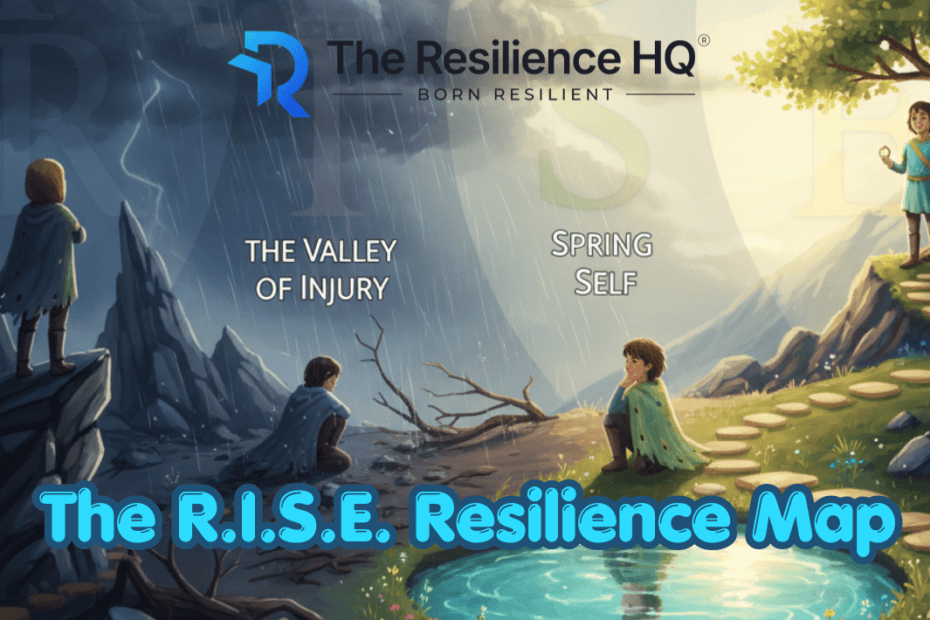
I teach this through a framework I call The R.I.S.E. Resilience Map, and it has changed practice in family homes and children’s homes across the country. Its four letters spell the word RISE and they map onto the journey every child with complex needs and looked-after child undertakes. Every parent and care worker can learn to guide the young person through this landscape.
- R – The Ridge of Reaction: the defensive, hard‑to‑reach place where survival armour is thickest.
- I – The Valley of Injury: the deep, painful story of trauma, loss, and unmet need.
- S – The Spring of Self: the hidden source of original strengths, talents, and identity.
- E – The Summit of Empowerment: the healed, wise, future self the child can co‑create with support.
The mnemonic is reminder to: Meet them at the Ridge, understand the Valley behind, discover the Spring, and guide them to the Summit.
To make this journey easy to understand, I often use a character many of us recognise: Thor, the Marvel superhero. His story is an amazingly accurate mirror of the R.I.S.E. trajectory, and carers or parents can use that map to connect with and understand the young person better. They can stop just managing behaviour and learn to start building futures.
R- The Ridge of Reaction: The “Difficult” Child You Meet First
In Avengers: Endgame, we meet a Thor we’ve never seen before. He’s overweight, drinking heavily, obsessed with video games, swearing at his friends, and furious at the world. He’s dishevelled, unshowered, and barely able to string together a plan. If you met him on a bad day, say, in a children’s home kitchen after he’d been asked to turn down the television, you would naturally write him off. You might call him lazy, aggressive, or difficult. You might decide he doesn’t want help.
This is the Ridge of Reaction: the present snapshot of defensive, explosive, or withdrawn behaviour that we walk into every single shift. It’s the sharp, windswept peak where survival requires armour, and it’s the version of the child we encounter first. As a child psychiatrist, this is what everyone wants us to see first and fix. It is called “Presenting Complaint”.
Now think of a young person in your care. Maybe it’s a boy who refuses to go to school, swears at staff, and spends every evening in his room, only emerging to raid the fridge. Or a girl who goes missing for hours, comes back high, and shrugs at every consequence. When you encounter a child on their Ridge of Reaction, your emotions react. You feel challenged, disrespected, perhaps even afraid. It’s human nature to judge what we see right in front of us. The problem is, we are almost always judging the end of a story we haven’t read.
What if we paused and asked: Is this who this child really is, or just the Ridge where trauma has stranded him?
I’ve sat in team meetings where a child is described entirely by their Ridge. “He’s violent.” “She’s manipulative.” “He smeared faeces on the wall again.” These are Ridge of Reaction descriptions. They are accurate, but obviously incomplete and don’t tell us anything about the causes or the solutions. When we stop there, we fail the child. And we burn ourselves out, because we start believing the child is the problem, rather than a young person clinging to a rocky outcrop in a storm we haven’t yet mapped.
I- The Valley of Injury: The Broken Child Behind the Behaviour
Let’s go back a little in Thor’s story. Before the drinking and the rage, Thor lost his father, watched his brother Loki die in front of him, saw his home world of Asgard destroyed, and then failed to stop the villain who wiped out half of all life. He was grieving, traumatised, and drowning in guilt. He believed he should have been able to save everyone, and because he couldn’t, he no longer deserved to be a hero. His Ridge of Reaction, the drinking, the anger, the withdrawal, was not laziness. It was the visible edge of a deep, hidden Valley of Injury.
The Valley of Injury is the trauma story that most of our young people carry in their bodies. It’s the pain, loss, and unmet need that lies beneath the surface behaviour. To understand the Ridge, you must be willing to descend into the Valley.
Let’s think about an 11 year-old boy who was placed in a children’s home after multiple foster placement breakdowns. Staff described him as destructive: he would tear up his bedroom, smash windows, and swear at anyone who tried to comfort him. He was labelled “conduct disordered” by a previous clinician. But when we sit down to piece together his developmental history, we see a different picture.
His mother used cocaine throughout her pregnancy. His father was domestically violent and left when he was six months old. By age three, he had been exposed to chronic neglect: left in a cot for hours, fed crisps and fizzy drinks because no one cooked, and found wandering the streets at night on two occasions. He entered care at four, and between the ages of five and eleven, he lived in seven different placements. Seven times he began to trust, and seven times that trust was smashed.
Now, when this same boy smashes a window, what are we really seeing? We’re seeing a child whose Valley of Injury is so profound that the Ridge of Reaction feels like his only safe and familiar place. The destruction is not random, it’s a survival strategy designed to push people away before they can abandon him again. If we don’t know the Valley, we discipline a traumatised boy for the symptoms of his abuse. And that, is a tragedy we can prevent.
Residential staff are often told to “understand the child’s history.” But too often, that history stays in a file on a shelf. The R.I.S.E. Map makes the history visible and emotionally real. Ask your team: What is the Valley of Injury that makes this Ridge of Reaction make sense? When you really sit with the answer, something in your psyche shifts. You stop wanting to punish or correct, and you start wanting to heal.
S- The Spring of Self: Who Were They Before Trauma?
Now rewind even further. Long before the Valley of Injury swallowed him, Thor was a prince of Asgard. He was arrogant, yes, and hot-headed, but he was also brave, witty, fiercely loyal, and surprisingly tender with those he loved. He believed in himself. He had a sense of humour and a deep desire to do good. This is the Spring of Self: the original source, the child before the world broke them. It’s the buried but still flowing well of identity, talent, and spark that trauma cannot fully extinguish. In psychiatry, we call it “PreMorbid Personality”.
Every single child in your care has a Spring of Self. It is often hidden under layers of neglect, violence, and loss, but it is there. And our job is not to invent it, it’s to rediscover it and let it flow again. Every complex child or young person that was transferred to me from others, this reconnection with the spring helped them and parents feel hopeful and make progress.
Discovering the Spring of Self often involves detective work. It lives in old school reports, photos, fleeting memories shared by grandparents, or a skill that emerges during a rare relaxed moment. It can be as simple as noticing that the “angry” boy in room 4 becomes calm and focused when he’s allowed to fix a bike chain. That skill, that spark, is a window into his Spring, the curious, capable child who still exists, waiting for the right conditions to resurface.
When you shift your lens from “What’s wrong with her?” to “What strengths and dreams did she have before the Valley swallowed them?”, you uncover hope. And hope is not a luxury in residential care; it’s a necessity without which, cycle repeats itself.
E- The Summit of Empowerment: The Healed, Wise Future Self
At the end of his story, Thor reaches a place that none of us predicted. In Endgame, despite the chaos and grief, he becomes a different kind of hero. He is still strong, but he’s no longer driven by ego. He has learned to lean on others, to share leadership, to be emotionally honest. He’s wiser, gentle, and able to find meaning beyond being the star. This is the Summit of Empowerment: the healed, resilient, integrated self. Not perfect, Thor still had bad days and extra pounds, but able to manage his emotions, form healthy relationships, pursue meaningful goals, and give something back.
In our work, the Summit of Empowerment is the child’s co‑created future vision. It’s what we are aiming for every time we show up with consistency, compassion, and high expectations. Crucially, this is not a destination we impose. It has to be built together, with the young person holding the compass.
That means sitting down and asking questions like: If things were better in a year, what would be different? What kind of person do you want to become? What are you proud of already? For some young people, these questions will be met with a shrug or silence. That’s fine. Plant the seed anyway. The key worker’s steady presence, day after day, month after month, is the path that leads from the Ridge to the Summit.
Let’s consider this unfolding with a young man named “Devon.” He entered care at 13 after years of physical abuse and exploitation by a county lines gang. His Ridge of Reaction was terrifying: weapon possession, calculated intimidation of staff, running drugs. Some professionals had written him off as a “dangerous offender in the making.” But his Valley of Injury was a boy who had been beaten by his father and groomed by older males who offered him money and belonging. His Spring of Self, found in a single school report, was a child who “showed remarkable kindness to younger pupils” at age 7.
Over three years, a team of residential workers, led by a key worker who refused to give up, held onto that kind 7‑year‑old. They set boundaries, but they also celebrated every glimmer of Spring-like behaviour. They got Devon into a boxing programme, where he found discipline and an outlet for anger. They involved him in cooking meals for the home, tapping a hidden talent. Slowly, the Summit of Empowerment emerged: a young adult who wanted to become a youth worker himself, to “stop other kids going through what I did.” Two years later, he enrolled in a college course in health and social care. That is a young man walking his own R.I.S.E. path.
How the R.I.S.E. Resilience Map Changes Your Practice Immediately
You might be thinking, This sounds inspiring, but I’m drowning in daily incidents, understaffed shifts, and constant crises. How do I bring this onto the floor?
Here are four things you can do tomorrow.
- Name the waypoints in shift handover. When a young person has exploded, before you talk about consequences, ask the team: “What waypoint did we just see, the Ridge of Reaction? What might be happening down in their Valley of Injury?” This simple language shift changes the emotional temperature of the whole room.
- Create a “My R.I.S.E. Map” board. With a child’s permission, help them draw their own landscape: a mountain with a Ridge, a dark Valley, a bright Spring, and a Summit. Let them place words, drawings, or symbols at each spot. This becomes an unfolding map for both child and staff on difficult days.
- Check yourself before reacting. When you feel your own frustration build, pause and ask silently: “Am I reacting to the Ridge? What if I responded to the Valley instead?”. Sometimes, just lowering your voice and saying, “I can see you’re really upset right now, I’m not going anywhere,” is enough to guide a young person off the Ridge without a battle.
- Share the map with your team. Print a simple visual of the R.I.S.E. Resilience Map, the mountain, the valley, the spring, the summit, and pin it in the staff office. Use the language in handovers. When a child moves from one shift to the next, a shared map keeps the whole team navigating in the same direction.
It is possible to reduce physical interventions by adopting this framework within weeks and months. Not because the children become magically compliant, but because the adults stop escalating situations by reacting to the Ridge as if it were the entire terrain.
A Real-World Shift: What Happens When You Navigate the Whole Map
Maria (not her real name) had been a residential care worker for a few years. She was good at her job; firm, fair, experienced. But she was burning out. There was one teenager, “Connor,” who triggered her more than anyone. He would call her horrible names, refuse every request, and once spat in her face. Maria told her supervisor she was starting to dread her shifts.
Following a training session on the R.I.S.E. Resilience Map, Maria was asked to take Connor’s file and spend twenty minutes reading his early history aloud with a colleague. She didn’t want to. She’d read it before, she said. But she did it anyway. And this time, she was asked to look specifically for his Valley of Injury and his Spring of Self.
What she found was that Connor’s mother had died of an overdose when he was three, and he had been the one to find her body. He’d then been moved between an uncle who didn’t want him and an emergency foster placement where he was physically harmed. She found one line in a school report from Year 2: “Connor is always first to help tidy up and often comforts other children when they cry.”
Maria later said that she cried that evening. She realised she had been meeting Connor on his Ridge of Reaction with her own defensive armour. The next day, she didn’t demand anything from him. She sat next to him while he watched TV, said nothing for fifteen minutes, and then quietly commented, “I read you used to be really good at helping tidy up. I wonder if you’d like to help me sort the art cupboard later?” Connor didn’t respond straight away. But an hour later, he appeared at the art cupboard door and, without a word, began sorting pencils.
That was the beginning of a relationship that, over the following year, turned one of the most “difficult” young people in the home into a young man who could trust again. Not perfectly. Not overnight. But enough. Maria later recalled, “I stopped seeing the Ridge as the whole person. I started looking for the Spring. And that’s when everything changed.”
A Question to Leave You With
Before you go back onto shift, I want you to think of one young person. The one who gets under your skin the most. The one whose name makes you sigh when you see it on the rota.
Ask yourself these four things, using the R.I.S.E. map:
- Ridge: What behaviour am I meeting today?
- Valley: What wounds lie underneath that Ridge?
- Spring: Can I find one glimpse of the original, pre‑trauma spark?
- Summit: What is one small thing I can do this week to help them move one step toward their best possible future?
You won’t always have the answers. That’s okay. The simple act of asking these questions, consistently, rewires how you see the child. And that changes everything you do.